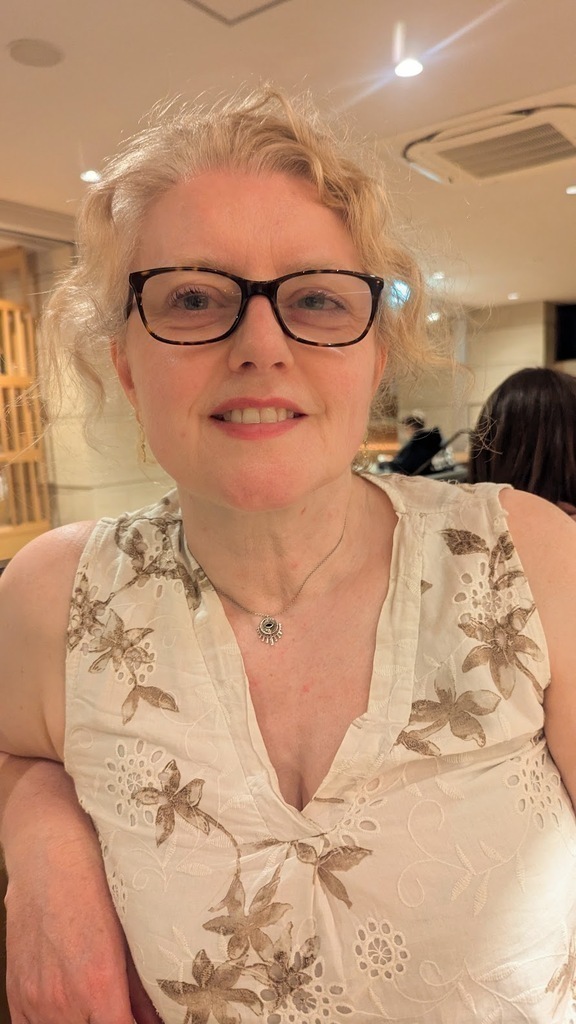
Day 5: Monday 18th May
Tokyo to Kyoto
🚄 Tokyo to Kyoto
Birthday Treat & Goodbye To Tokyo
I snuck out of the hotel for a morning walk and brought back a take-away latte and carrot cake from Cafe Ortiga as a birthday treat for Maria. 🥰💕💕
We had a mad hurry to get packed and checked out of the hotel. There were signs up that let you know that you would be charged for every slot of 10 minutes after checkout time. Although we were only carrying hand-luggage, it did mean that there wasn't much space, so somehow things had spread out a bit and expanded and we were having trouble getting the little suitcases to shut. Stress!
We checked out of the hotel, but managed to spend a few minutes in the lobby rearranging stuff a bit and getting ourselves ready to head out for Tokyo Station to catch the Shinkansen to Kyoto. Both of us had been struggling with sleep and were pretty exhausted already. We felt like we were running on overdrive. In a way, I guess we were kind of looking forward to the downtime that we would get with the commute to Kyoto.
The Shinkansen Experience
Tokyo Station was busy, and it took us a while to work out where we needed to be, partly because of our approach to the station which involved a 15 minute walk from one of the underground lines. When we got there, we found out where we needed to be to catch the Shinkansen and then tried to look for the famous 'ekiben' stores to grab some lunch for the journey. This proved to be more difficult than we had been led to believe, because these are really just little shops around the station, not dissimilar to the convenience stores around Tokyo, only much smaller and with much less selection of food.
A bit of clarification on 'ekiben', which is derived from 'eki' meaning station, and 'ben' for 'bento'. Basically this is just a bento box bought at the station for eating on the Shinkansen, one of the few places where it is acceptable to eat food in public outside of a restaurant or designated area. Personally, I think this has turned into more of a tourist fad thing than anything that exciting. Many Japanese people don't seem to bother with this, or buy something small to eat. The shops have capitalised on the concept though and there are piles of pretty looking boxes that contain food that you can buy. The boxes are labelled almost entirely in Japanese, without English translations, which makes it really difficult to select something that you actually want. And there is almost certainly nothing vegetarian available - or at least nothing that we could find. Often they are a selection of meats, so even if you're a fish-only kind of person, you're likely to end up with some pork or something anyway. This was quite different to food in most convenience stores, which usually included an English translation.
I skipped buying an ekiben and just bought a couple of onigiri, which are rice balls in a triangular shape and wrapped in seaweed. These have different fillings, often meat based, but the pickled plum flavour is good, and also the kelp flavour. Onigiri are such a healthy lunch snack and are a perfect alternative to eating a sandwich. I kind of wish they were more available at home in the UK.
Maria bought an ekiben and nibbled on it during our journey. There was definitely much use of Google Lens as she tried to work out what she was eating. Unfortunately all of the text for contents is tiny and solely in Japanese, so it is near impossible to do this in a busy station with lots of queues and people pushing past. We found the process of buying food for the Shinkansen way easier when we were coming back from Hakone.
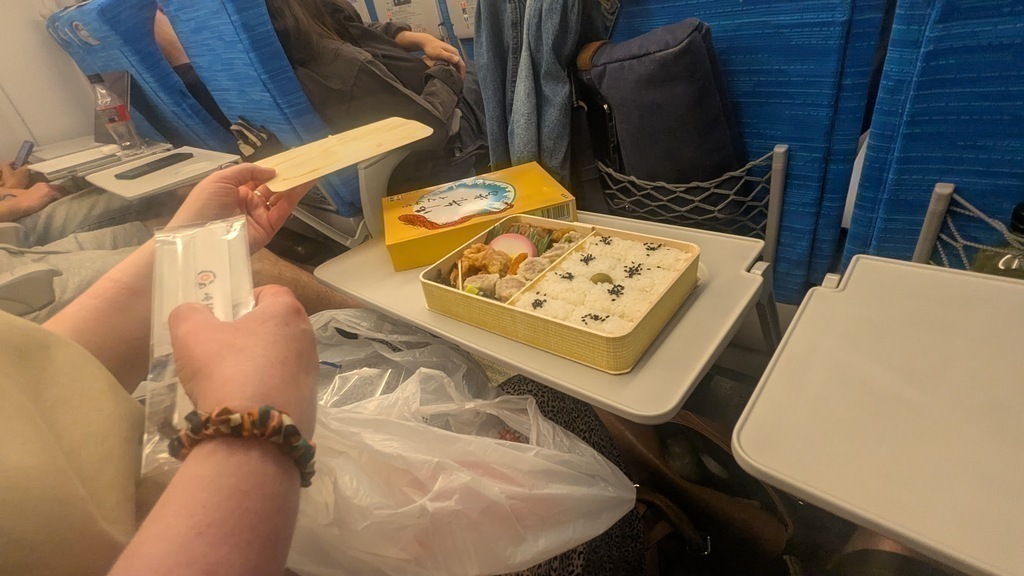
We caught the Shinkansen to Kyoto - departing 12:12, arriving 14:25. These trains run frequently, and while we had booked and reserved seats (particularly to catch a view of Fujisan on the way to Kyoto), you probably don't really need to book far in advance and could quite feasibly just get a ticket at the station on the day you're travelling. The trains are clean, comfortable, and air conditioned. And obviously fast! Commonly referred to as the bullet train in Western countries, you don't quite appreciate how fast these move until you're on them. Once out of the station and main city areas, you kind of feel like you're on a plane careering down the runway, just for a couple of hours of it. The world buzzes past really fast and it is uncomfortable looking at anything close to the train. Stuff in the distance is okay, but you definitely can't stare out of the window for a long period without feeling a little bit dizzy after a while. As I mentioned, a big point of interest heading out of Tokyo or back to Tokyo is to capture a view of Mt Fuji. We were travelling on a particularly clear day and got an exceptional view of it for the 7 or 8 minutes that it is visible. We later heard that Fuji is only fully visible for around 60 days a year, because of cloud cover. So these are pretty good pics.
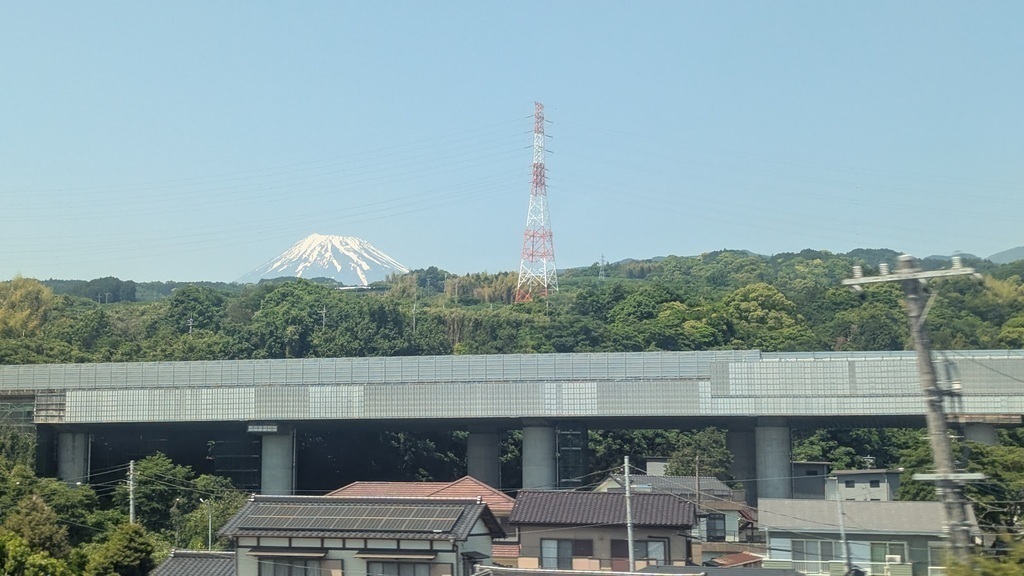
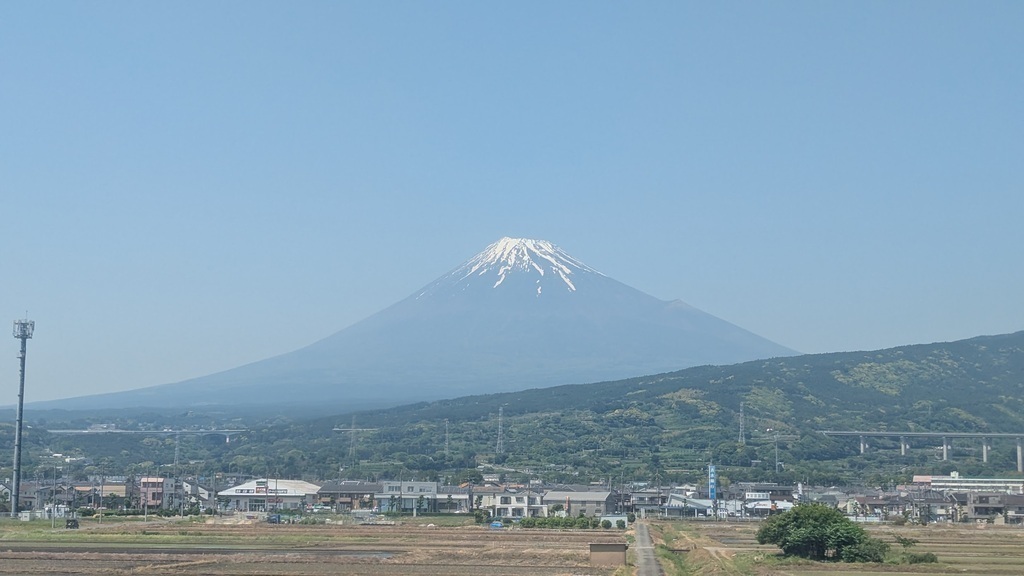
To be honest, once I had a pic of Fuji, I nodded off on the train. I needed the sleep and there were only so many rice paddies and tea plantations that I could take in at speed.
Kyoto Arrival
Kyoto suddenly felt so much calmer than Tokyo. Perhaps it was the time of day, but we got off the train and although it was baking hot (34°C) the walk to Sakura Terrace Hotel felt languid - even if we were trying to find every bit of shade along the way.
We checked into the hotel which felt nice and cool, and appreciated our more spacious room and bathroom. Reception let us know that we could claim a free drink in the foyer and listen to live music every night from 7pm until 10pm. Also, there were massage chairs, free to use on a little balcony overlooking the foyer. Vending machine in the laundry room, with coffee, green tea, water, and beer. Nice.
Once we had cooled down a bit, we went for a late afternoon walk. Just outside of the station, on the North side is Higashi Hongan-ji, a large Buddhist temple. This was already closed, but we walked around the perimeter and took pictures because it just looked really impressive.
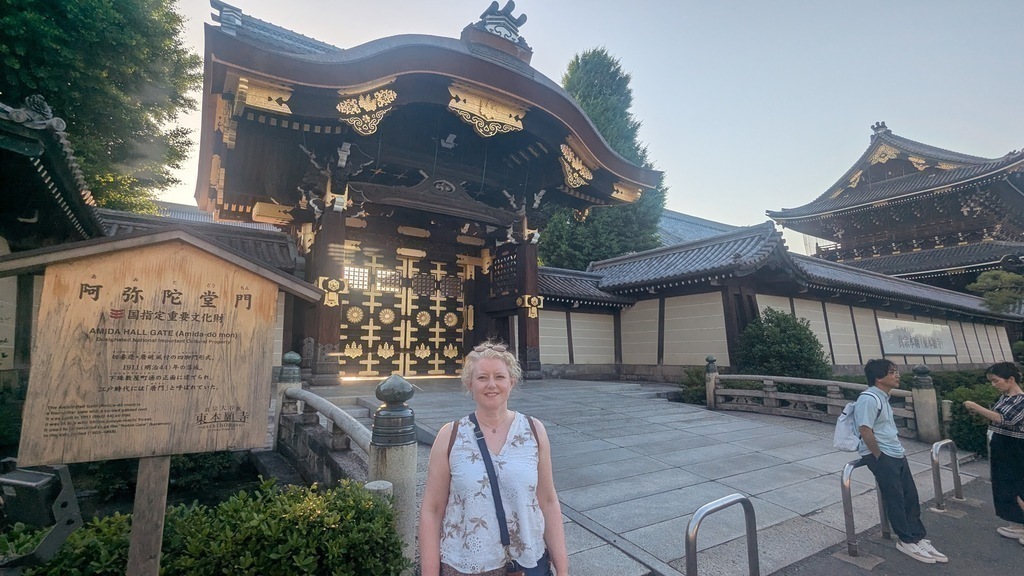
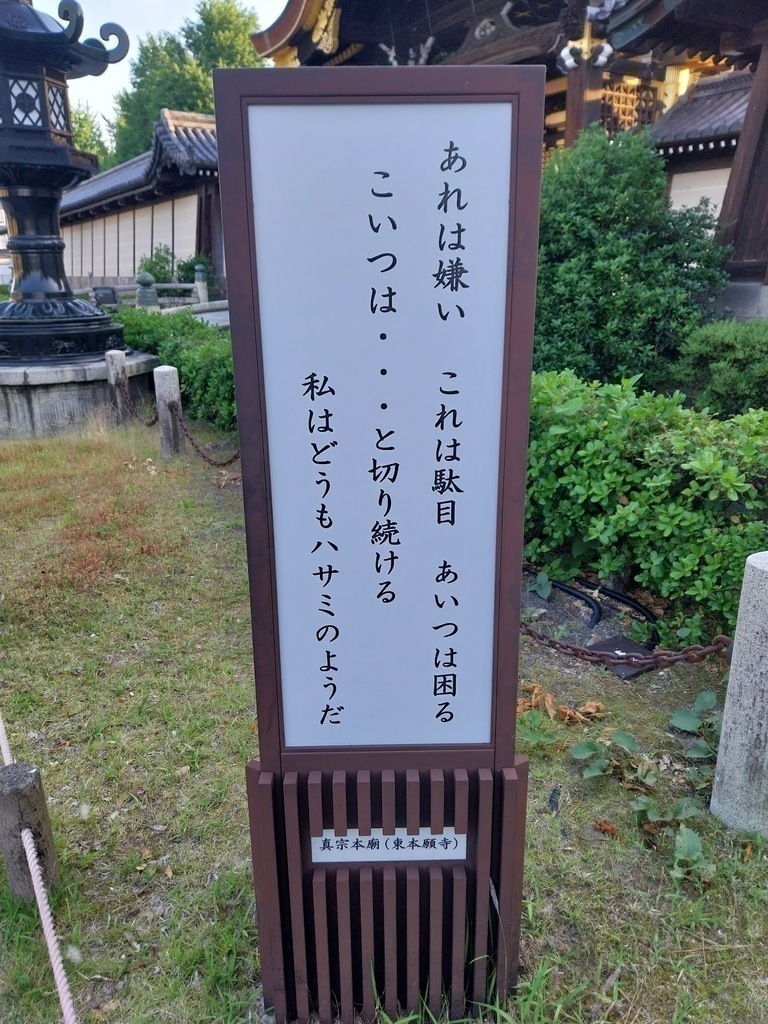
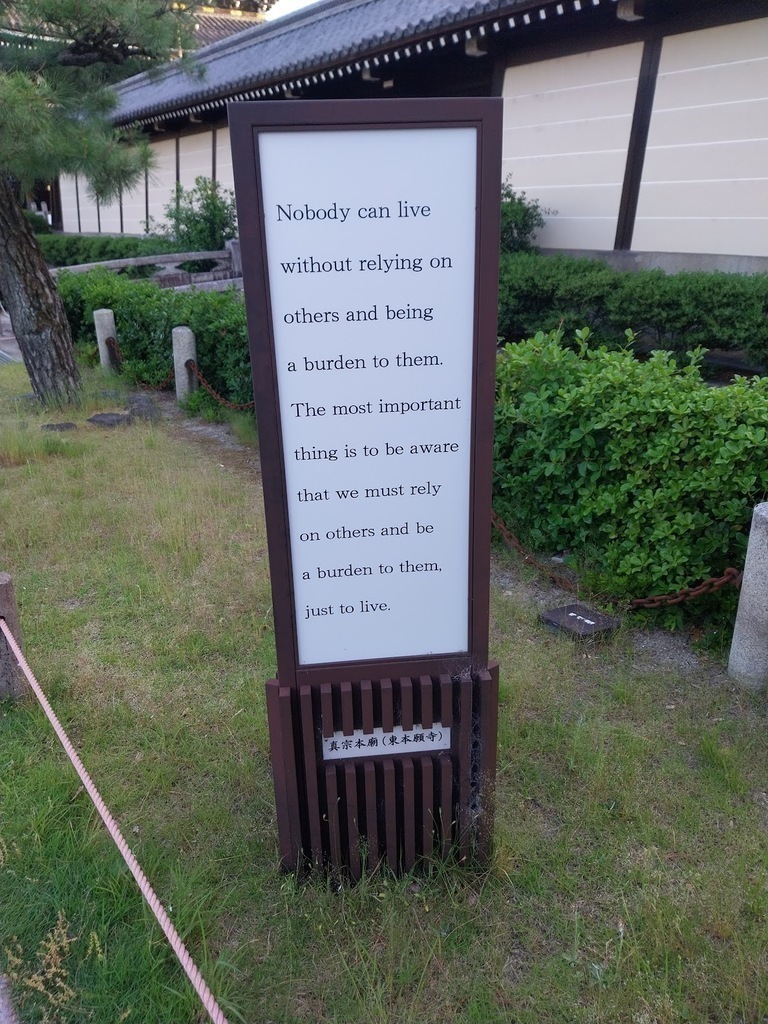
Lining the streets alongside the temple were all these signs that provided little Buddhist koans or hogo (life-guidance quotes). The signs had the text in Japanese on one side and then in English on the other. The sayings are good reminders on how to navigate the struggles of being in the world. We could do with more of these things around cities and in public spaces.
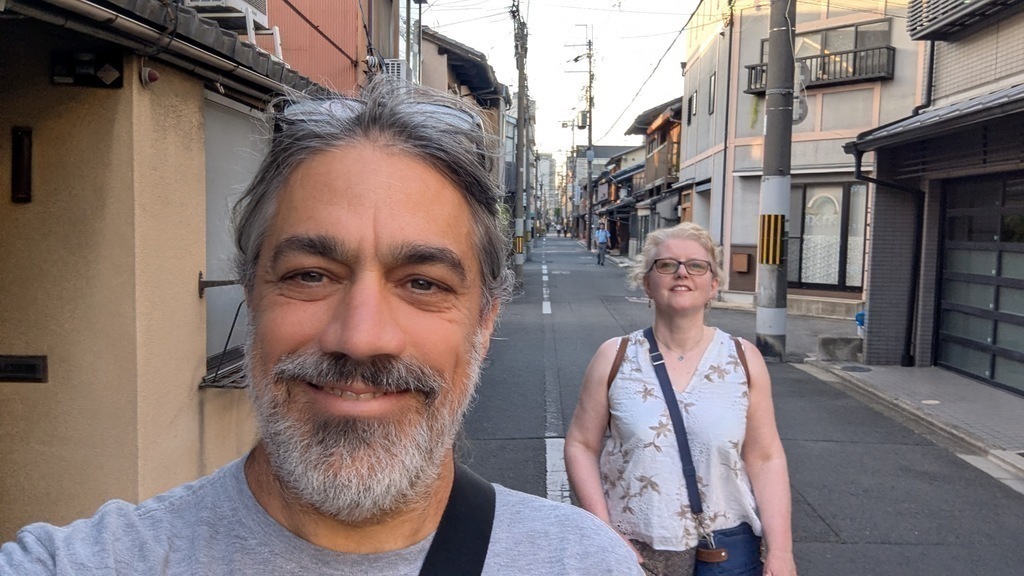
We continued around the block and ended up walking down a suburban street, right in the middle of Kyoto. It felt peaceful and somehow like we weren't in a big city that used to be the capital of Japan, little over a century ago.
Stomachs were grumbling. It was Maria's birthday. I needed to make a plan for dinner soon. Google google google. Everything felt like it was a mission to get to. I was starting to stress about where we would eat. The number one priority when an O'Connell is on holiday is where the next food is! Eventually I found a place called the Mercy Vegan Factory, which was apparently not far from the station, had excellent reviews, and which served an interesting spread of Japanese themed cuisine.
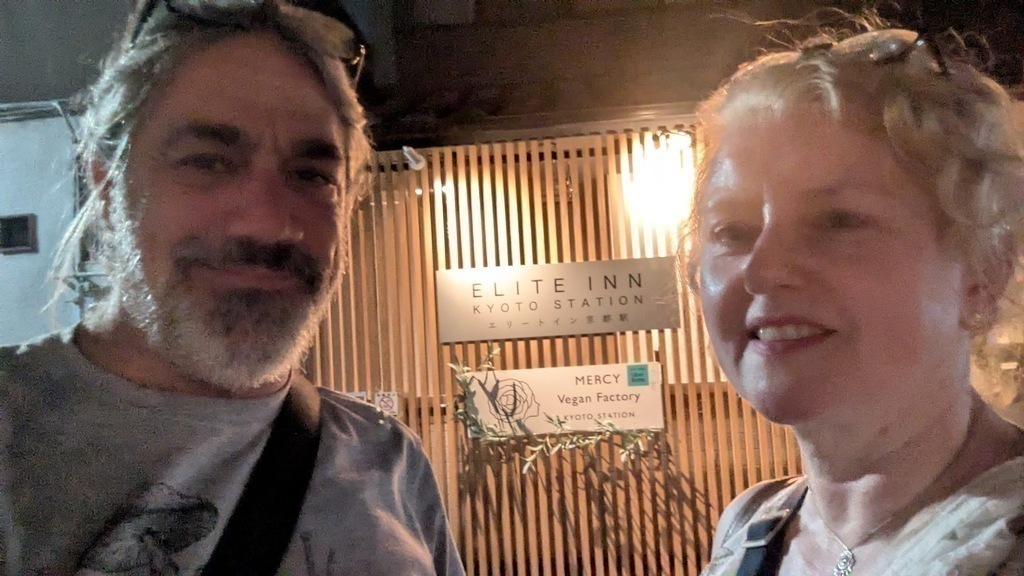
Some Google navigation mess later, we eventually found ourselves at the restaurant, which seemed to be part of the Elite Hotel, but which was in the basement and accessible from the street. We went down the stairs and the restaurant was full. I felt my heart sink, but we were told to wait 5-10 minutes for a table. It really didn't even take that long and we were seated at a table perusing the menu. The food was delicious, and for any vegetarian/vegan in Kyoto, I recommend stopping in here. We went for the Shoujin Sushi Course and the Grilled Chirashi Sushi Course. With the grilled chirashi sushi, you actually end up rolling your sushi yourself. It is an experience in itself.
Kyoto Station Magic
Well fed and happy, we walked back to Kyoto Station and tried to find our way up to the famous Roof Garden. We somehow went up the back way using an escalator that meant that we got to the top before actually seeing everything at once. This was wonderful, because the station just kept revealing itself to us... kind of like a hermeneutic circle experience. 💖
So the elevator opened and we stepped out onto the roof of the station. It was evening and we were on the far side. Ahead of us we could see planters containing living bamboo all around and benches. A few people were around, but it wasn't well lit here so we wandered over and saw that you could look out over Kyoto from the garden area. It really felt like a peaceful space. I regret that we didn't pop up here in the day to see how busy it gets, but it definitely makes a great place to visit in the evening.
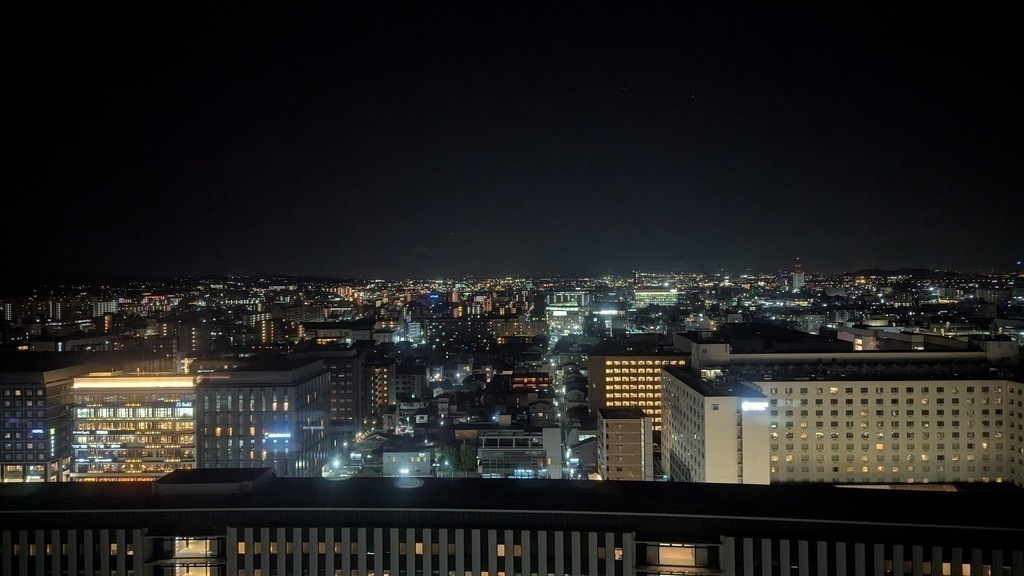
We noticed that there seemed to be a main entrance to the garden ahead, and some lighting so we moved to that and looked down into the station interior. Oh wow, we weren't expecting this. It really is an architectural marvel.
The following text is from a sign on the station roof:
Kyoto is a gateway to history.
History can be understood from a geographical perspective. For example, Heian-kyo (Old Kyoto) is carved in the present day urban fabric. The architecture of Kyoto Station is intended as a formalization of this statement through the realization of the Geographical Concourse, the primary expression of the gate. Each day, people will traverse this 27-meter wide, 60-meter high, 470-meter long concourse, as if traveling down the side of a mountain into the valley basin. The glass shelter over the concourse represents the traditional Japanese aesthetic of a boundary, yet not a boundary. A person traversing the station will recollect the sky. The formalization of the gate is like designing Kyoto's sky. The Matrix is a podium supporting the gateway, a floating stratum. Its random column spans and frame delineate not only the infrastructure and various functions of the station but those of the city and their delineation by its grid-patterned streets. Principal facilities - the station, multiple commercial, convention center and hotel, cultural and parking - together with other co-existing diverse elements are juxtaposed upon it. The term, matrix, formed in the Renaissance period and referred to a situation or surrounding substance within which something originates, develops or is contained. in other words "a womb." The railway station, a symbol of machine-age architecture, provided a stage upon which people met and parted. The Matrix functions as fragment of Kyoto's womb, a stage upon which people experience various passages of their life. The northern facade, the primary face of the gate, often appears to lie in shadow when viewed from the plaza. Glass is generously used to brighten this facade. As a result the building may disappear or appear to float in the air. The subtle transitions of the northern light reinforce this modality.
JR Kyoto Station Reconstruction Competition: Design Concept Architect: Hiroshi Hara
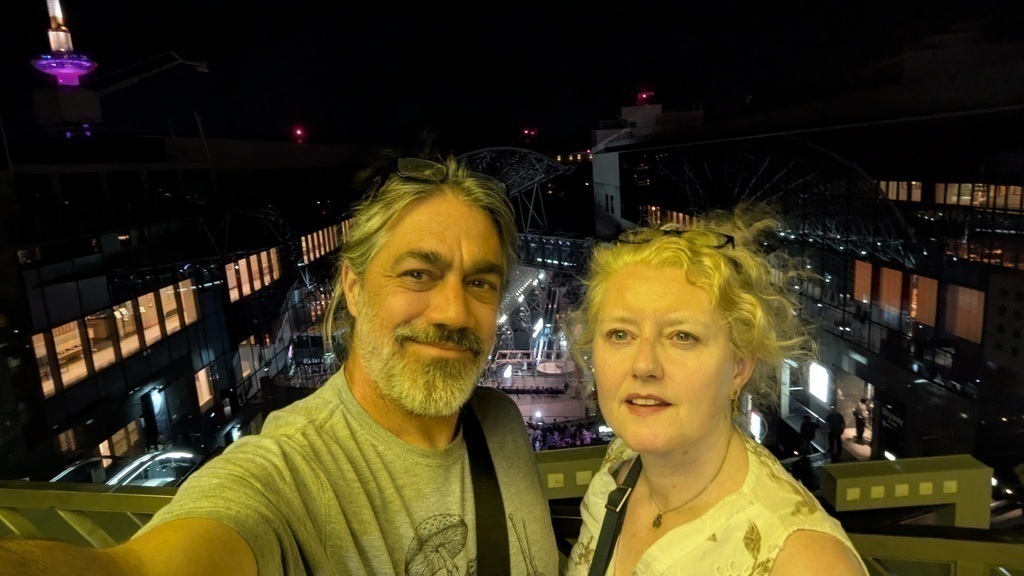
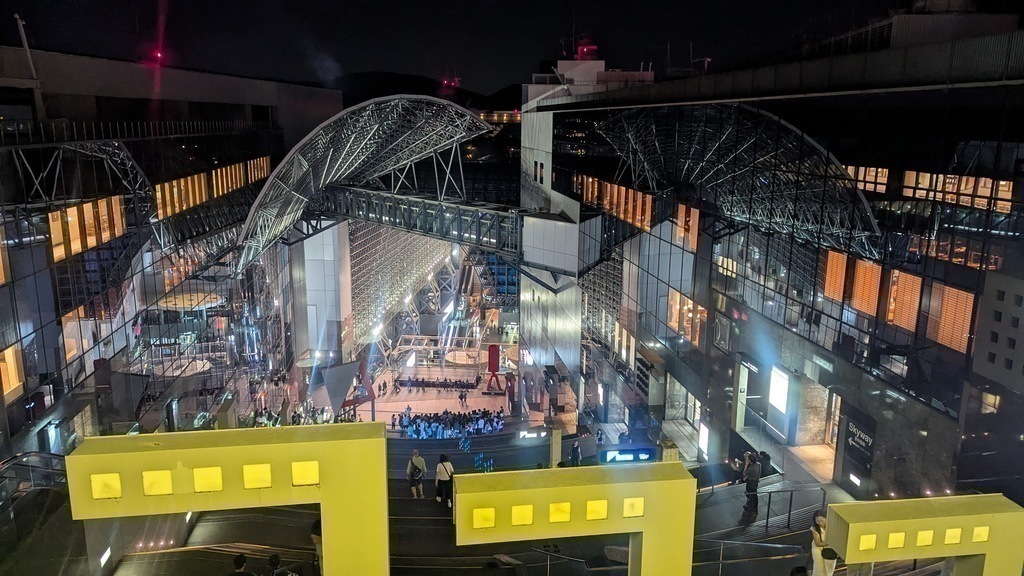
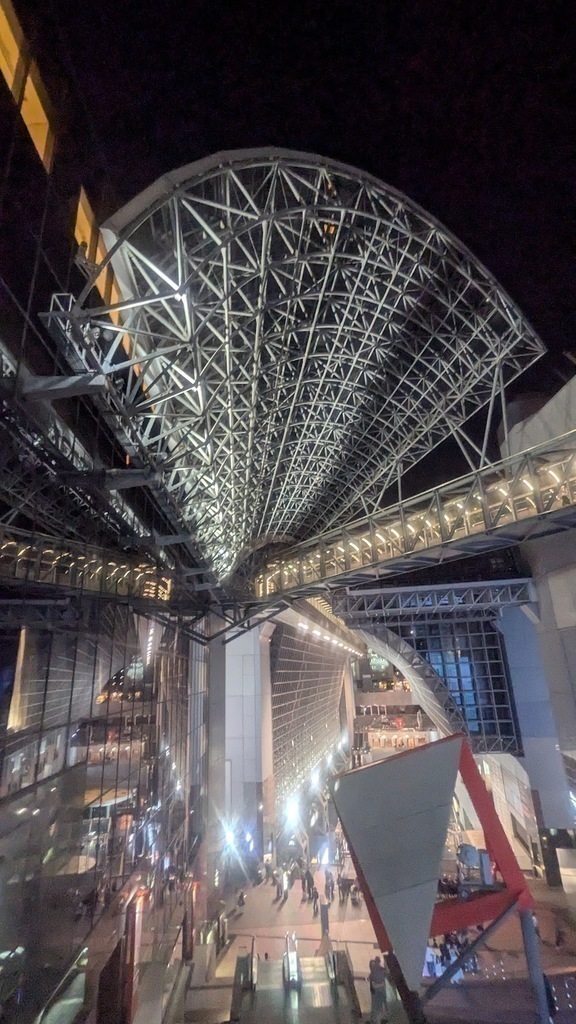
It is hard to capture everything in pictures, but the station is definitely worth exploring as a destination in itself, if you're visiting Kyoto. Perhaps the real finale for us was the light show which we caught on the central steps that run up the station building all the way up to the rooftop somewhere up on the 14th or 15th floor. The display transforms the staircase into an art installation after the sun goes down. People gather to watch the show, some people try to get in on the action by standing on the steps during the show. I caught a bit of it in the video below. The video, like the pictures, doesn't quite do this all much justice, but it should give you an idea of the marvel that is part of Kyoto station.
Sakura Terrace Free Drinks
The evening was getting on and we were quite tired. Also, we wanted to claim our free drink at the hotel. So we padded down the streets from the station, relieved that we had booked a hotel about 10 minutes walk away. We got back to the hotel and headed straight for the bar where we were able to choose from some simple cocktails, or we could have beer or wine. Each of us picked a cocktail, and then went to find a seat in the lounge where we could listen to the 'quasi-live' music that had been pre-recorded or which was being video streamed to the hotel. To be fair, this only happened on the first night. There was real live music every other night, and the musicians were all pretty excellent.
Both of us appreciated the change in pace and felt pretty ready to explore Kyoto further the next day. Early to bed, because we had a big day with an early start coming up next.